Tudor Arghezi
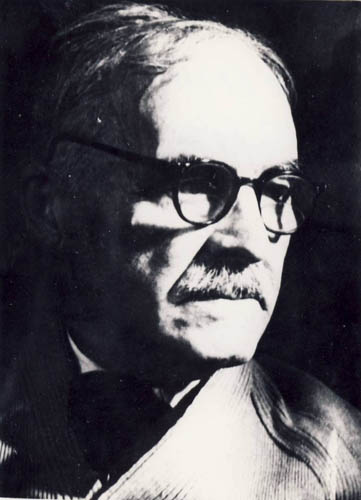 Tudor Arghezi (; born Ion Nae Theodorescu; 21 May 1880 – 14 July 1967) was a Romanian writer and political figure, widely considered one of his country's greatest poets (second only to Mihai Eminescu). An illegitimate, part-Hungarian, child who was purposely vague about his roots, he had a troubled youth during which he held a variety of jobs—including a stint as a hierodeacon of the Romanian Orthodox Church, from which he gathered his extreme anti-clericalism. He debuted in the 1890s as an affiliate of the Symbolist movement, being welcomed as an outstanding poet. Arghezi renounced this career to study theology in Switzerland, but never graduated, training instead as a watchmaker and typographer. From 1910, his social poetry and leftist journalism became widely read, allowing him to return as a professional writer and art columnist. He soon became highly controversial for his apparent corruption and his mordant satire, as well as for his political positions during World War I—when, as editor of ''Seara'' and ''Cronica'', he favored the Central Powers. Arghezi stayed behind in occupied Bucharest after The Romanian Debacle of 1916, collaborating with the German Empire in a manner that was judged as treasonous. In postwar Greater Romania, he was initially punished with imprisonment at Văcărești (an experience which informed his interwar poetry and prose), but amnestied within months of the verdict.
 Arghezi returned to political journalism, frequently changing sides and patrons, but remained constant in his promotion of avant-garde literature. Credited with having discovered the similarly influential Urmuz, he set up his own review, ''Bilete de Papagal'', which helped launch careers. He only published his poetry as books when he was in his forties, becoming instantly famous. Initially well-liked for his bridging of modernist literature and thematic traditionalism, he became reviled, especially in conservative circles, for the extreme naturalism and grotesque expressionism found in his subsequent works. Arghezi had a consuming dispute with the nationalist ideologue Nicolae Iorga, but never fully rejected nationalism, and seemingly agreed with conservatism, as well as with far-right groups such as the Iron Guard, on a number of topics. By 1930, he was a virtual client of the authoritarian King, Carol II, who also intervened to silence Iorga's opposition. Largely with money obtained from Carol, Arghezi maintained his estate of ''Mărțișor'', located outside his former prison; it is known as the setting of his other poetic cycles and his children's literature, which address the beauties of family life. For a while, he was absent from literary life due to a misdiagnosed disease, and preserved from this a hatred of the medical profession.
Initially, Arghezi was protected by Ion Antonescu, who, as dictator of Romania, aligned the country with Nazi Germany. He wrote a number of regime-sanctioned texts, including at ''Informația Zilei'' daily. In 1943, he published a satirical piece targeting Germany's envoy, Manfred von Killinger; though this text was likely vetted by some members of the governing apparatus, he was briefly interned at Târgu Jiu, and as such obtained cult status in anti-fascist circles. Upon Antonescu's toppling in 1944, he resumed publication of ''Bilete de Papagal''; this period inaugurated his ambiguous relationship with the Romanian Communist Party, alternating polite cohabitation and outspoken independence. Eventually singled out as a "decadent" and inimical figure, he found himself censored throughout the 1948–1953 interval, only finding work as a translator. He was progressively rehabilitated during the early stages of de-Stalinization, but only in return for major concessions to the official dogmas of Marxism-Leninism. Seen by his critics as extremely controversial for his quick adaptation to such tenets, he was defended by others as constrained by circumstances, and salvaging whatever was left of pre-communist culture. He was the subject of a cult of personality from the late 1950s, and served a term in the Great National Assembly.
By the time of his death at the age of 87, Arghezi was a member of the Romanian Academy and a receipient of the Herder Prize. While widely disliked for his political compromises, he remains universally acclaimed for his talent, his inventiveness, and his reshaping of the literary language. He took pride in upgrading the lower-class register of speech, seeing this as one of his missions, and also extensively used the Oltenian dialect, with which he identified culturally. In his creation of new poetic forms, he also borrowed the conventions of Christian poetry to contextualize his own embrace of agnosticism and delving into heresy. Arghezi was an unusually scrupulous poet, who imposed himself formal constraints even as a youth; he is less celebrated as a novelist, since his work there was less rigorous, often creating prose poetry rather than full-fledged epics. His immense literary output was reissued in critical editions that took almost five decades to print, with his children Mitzura and Baruțu serving as curators. His first-born and estranged son was the expatriate photographer Eli Lotar. Provided by Wikipedia
-
1
-
2
-
3
-
4
-
5
-
6
-
7
-
8
-
9
-
10Published 1963Other Authors: “…Arghezi, Tudor…”
Classmark: [mehrbändig! Sign. s. bei den Bänden]Book